
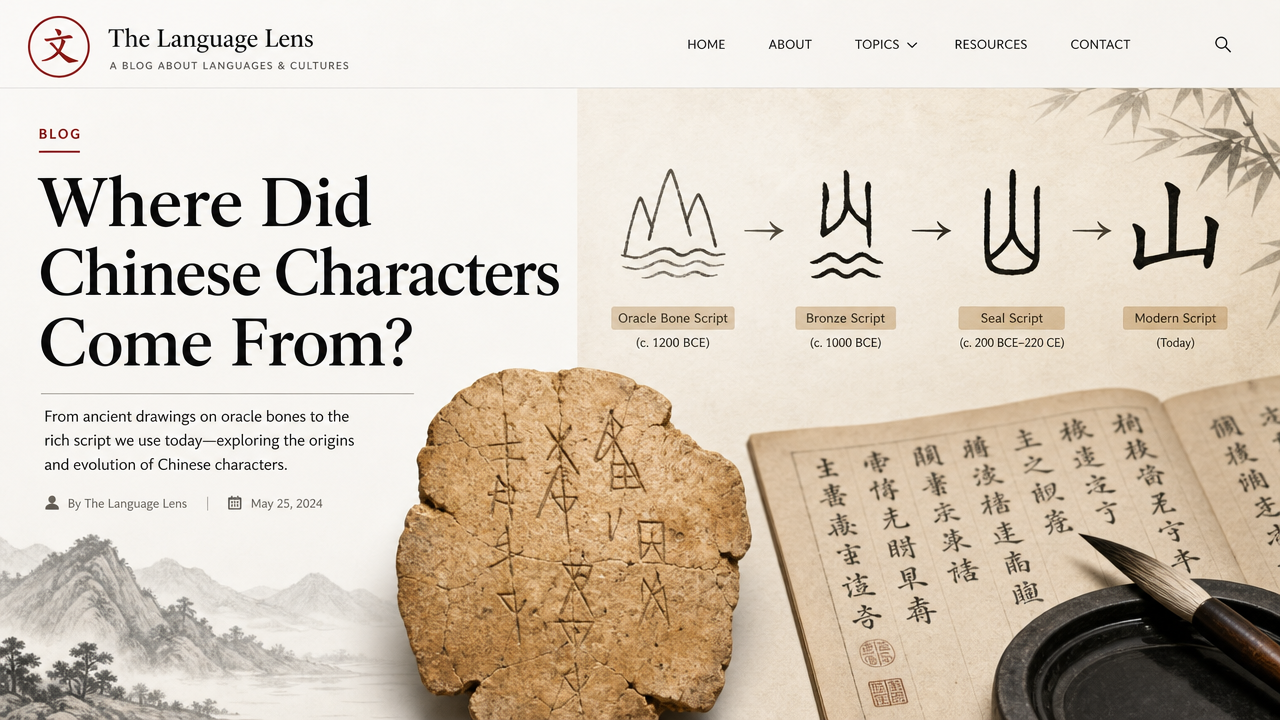
Chinese characters did not begin as random symbols. Many started as drawings, then evolved into structured written forms built from meaning components, sound clues, radicals, and centuries of simplification.
Chinese characters are not an alphabet. Each character usually represents a syllable and carries meaning.
Most characters are not simple pictures. Many combine a meaning component with a pronunciation clue.
Learn characters through radicals, components, stories, stroke order, and real words.
Chinese characters are one of the world's most recognisable writing systems. To new learners, they can look mysterious, beautiful, and intimidating all at once.
Unlike alphabets, Chinese characters are not built from letters that directly spell out sounds. Instead, they are made from components that can carry meaning, pronunciation clues, or both.
Chinese characters become much easier when you stop memorising them as isolated pictures and start seeing their internal structure.
1. Chinese Characters Are Not an Alphabet
English uses letters that represent sounds. Chinese uses characters that usually represent one syllable and one unit of meaning.
| Writing system | Basic unit | Example | What learners notice |
|---|---|---|---|
| English alphabet | Letters | tree | Letters combine to spell a word. |
| Chinese characters | Characters | 树 | One character can represent a meaningful syllable. |
2. Some Characters Began as Pictures
The oldest Chinese characters often began as drawings of real-world objects. Over time, these drawings became simpler, more standardised, and easier to write.
sun / day
This character originally represented the sun.
moon / month
This character originally represented the moon.
mountain
The shape still suggests peaks.
tree / wood
The form is connected to the idea of a tree.
3. Some Characters Represent Simple Ideas
Some characters represent abstract ideas rather than physical objects.
one
two
three
above / up
4. Some Characters Combine Meanings
Some characters combine two or more meaningful components to create a new idea.
bright / clear
This character combines 日 sun and 月 moon. Together, they suggest brightness.
5. Most Characters Combine Meaning and Sound
The biggest breakthrough for learners is understanding that many Chinese characters are phonetic-semantic compounds: one part hints at meaning, while another hints at pronunciation.
mā / mother
The left part 女 relates to female or woman. The right part 马 gives a sound clue.
| Character | Meaning clue | Sound clue | Meaning |
|---|---|---|---|
| 妈 | 女 woman/female | 马 ma sound | mother |
| 河 | 氵 water | 可 sound clue | river |
| 请 | 讠 speech | 青 sound clue | please / request |
6. Radicals Are Character Building Blocks
Radicals are recurring components that help organise and interpret characters. They often provide a clue about meaning.
Often appears in words related to water, liquid, rivers, or washing.
Often appears in words related to speaking, language, or requests.
Often appears in words related to actions done by hand.
Often appears in words related to feelings, thoughts, or emotions.
7. Characters Changed Over Thousands of Years
Chinese characters evolved through many stages, from early oracle bone inscriptions to modern printed forms.
8. Simplified and Traditional Characters
Today, Chinese is commonly written using either simplified or traditional characters depending on region and context.
| System | Commonly used in | Example | Learner note |
|---|---|---|---|
| Simplified Chinese | Mainland China, Singapore | 汉语 | Often has fewer strokes. |
| Traditional Chinese | Taiwan, Hong Kong, Macau | 漢語 | Often preserves older visual structure. |
9. Stroke Order Matters
Chinese characters are written using strokes in a conventional order. This helps handwriting become faster, cleaner, and easier to remember.
Correct stroke order makes characters balanced and readable.
Writing in the same order creates muscle memory.
Stroke knowledge can help when using dictionaries or handwriting input.
10. How Learners Should Study Characters
The biggest mistake is trying to memorise characters as disconnected shapes. A better approach is to learn their structure.
Look for radicals, sound clues, and repeated elements.
Characters are easier to remember inside useful vocabulary.
Always learn character, pinyin, tone, and meaning together.
Simple explanations or stories make components more memorable.
A Simple Character Practice Routine
| Time | Activity | What it trains |
|---|---|---|
| 5 minutes | Review 5–10 radicals | Meaning clues and pattern recognition. |
| 10 minutes | Break down 3 new characters | Component awareness and memory. |
| 10 minutes | Read characters inside real words or sentences | Context, pronunciation, and meaning. |
| 5 minutes | Write each character by hand | Stroke order, recall, and muscle memory. |
Final Thoughts
Chinese characters may look intimidating at first, but they are not random. They come from a long history of pictures, ideas, sound clues, meaning components, radicals, and evolving written forms.
For learners, the goal is not to memorise thousands of symbols by brute force. The goal is to learn how characters are built.
Keep going — Chinese characters become much friendlier when you learn the stories and structures behind them.
Ready to make Chinese characters easier?
Use Polly2 to practise Chinese through stories, AI conversation, character review, pronunciation support, and structured Learning Journeys.
Start Learning Free