
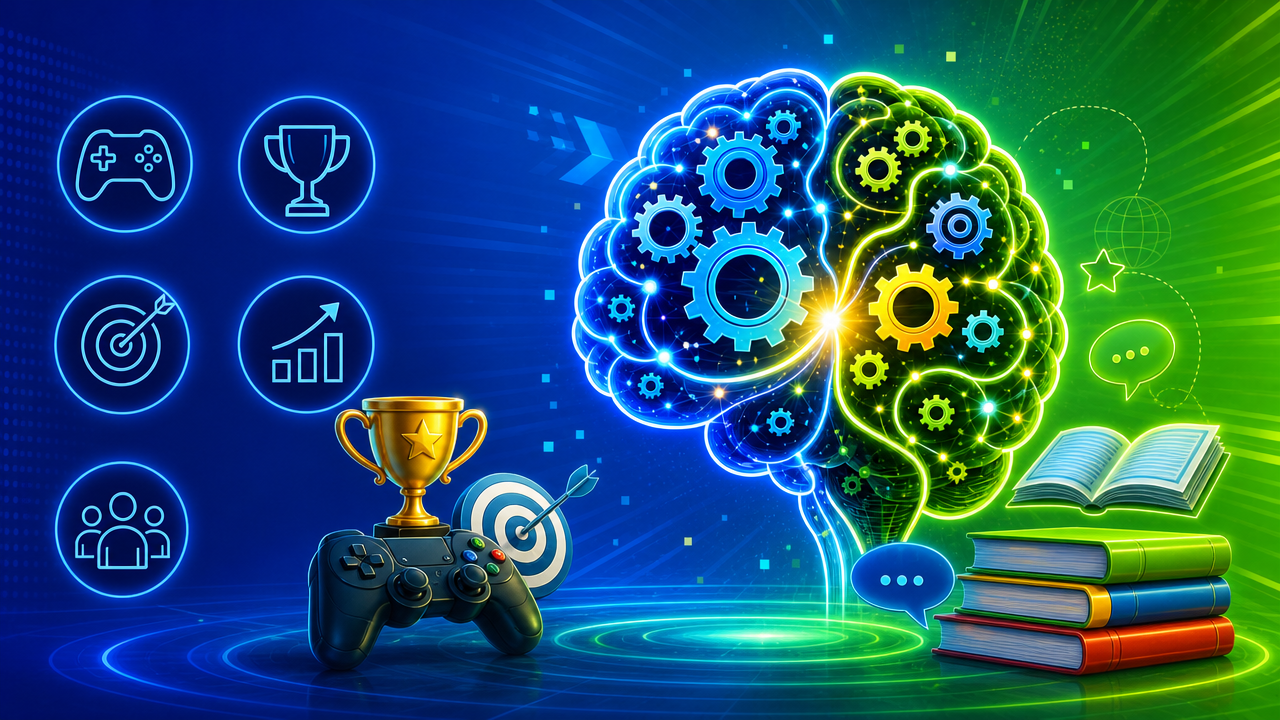
Well-designed games make language practice more active, more motivating, and easier to repeat. That matters because repeated, meaningful practice is what turns study into progress.
They turn passive study into active recall, decision-making, and feedback.
Visible progress, streaks, and personal bests make practice feel rewarding.
Use games to make repetition enjoyable, not to avoid practice altogether.
For decades, language learning was associated with textbooks, vocabulary lists, grammar drills, and endless repetition.
Then something interesting happened: researchers began discovering that some of the most effective learning experiences did not feel like studying at all. They felt like games.
When games are combined with competition, achievement systems, and immediate feedback, they tap into some of the brain's most powerful learning mechanisms.
Learners often spend more time practising, remember more information, and enjoy the process significantly more.
The Brain Loves Challenges
Imagine two learning activities.
The first asks you to read a vocabulary list for ten minutes. The second challenges you to answer as many questions correctly as possible while trying to beat your previous score.
For most people, the second activity feels more engaging.
Games create goals
Clear goals make practice feel purposeful.
Goals create motivation
Learners are more likely to continue when progress is visible.
Motivation creates action
Action produces more exposure, recall, and fluency practice.
Games Turn Passive Learning Into Active Learning
One of the strongest findings in educational research is that active learning consistently outperforms passive learning.
Reading notes is passive. Watching explanations is passive. Remembering information is active.
When you play a language-learning game, you are forced to recall vocabulary, recognise grammar patterns, make decisions, solve problems, and retrieve information from memory.
The act of remembering is itself a powerful learning tool. Every successful recall strengthens the memory.
Why Competition Increases Motivation
Humans are naturally competitive. Even people who do not consider themselves competitive often enjoy improving personal bests, completing challenges, earning achievements, climbing leaderboards, and unlocking new levels.
Competition creates a sense of progress, and progress is one of the most powerful motivators in learning.
The Power of Immediate Feedback
Imagine taking a test and waiting three weeks to receive your results. Now imagine receiving feedback instantly.
Immediate feedback helps learners correct mistakes quickly, reinforce correct answers, build confidence, and avoid repeating errors.
Games excel at providing this feedback. Every answer generates information. Correct answers reinforce knowledge. Incorrect answers reveal gaps.
Mistakes Become Opportunities
Many learners fear mistakes. Games change that.
In a game environment, mistakes become expected. They are simply part of the process.
Every incorrect answer reveals a vocabulary gap, grammar weakness, pronunciation issue, or misunderstanding.
The fastest learners are rarely the ones who make the fewest mistakes. They are usually the ones who learn from mistakes most effectively.
Games Increase Time on Task
Perhaps the biggest advantage of game-based learning is surprisingly simple: people spend more time doing it.
Language acquisition requires exposure and practice. The more meaningful interaction learners have with a language, the faster they improve.
Games make repetition enjoyable. Over weeks and months, those additional minutes add up dramatically.
Why Repetition Works Better in Games
Language learning requires repetition. There is no way around it.
Words must be encountered multiple times before they become automatic. Grammar patterns must be practised repeatedly before they become natural.
Games solve the problem of boring repetition by presenting familiar material in new situations and challenges.
| Traditional practice | Game-based practice |
|---|---|
| Vocabulary lists | Timed recall challenges |
| Worksheets | Missions and levels |
| Delayed correction | Instant feedback |
| Repeated drills | Varied challenges using the same material |
| Progress feels vague | Scores, streaks, achievements, and visible improvement |
The Science of Small Wins
Every completed challenge triggers a small sense of achievement. Small wins build confidence, increase motivation, reinforce effort, and encourage persistence.
Language learning can feel overwhelming because fluency is a distant goal. Games break that journey into smaller victories.
- Complete today's challenge.
- Improve today's score.
- Answer one more question correctly.
- Maintain a longer streak.
Why Story-Based Games Are Even More Powerful
The most effective language-learning games often combine two powerful learning tools: gameplay and storytelling.
Stories provide context. Games provide engagement. Together, they create a highly memorable learning experience.
When vocabulary appears inside meaningful situations, the brain forms stronger connections. Learners remember characters, situations, emotions, and outcomes, not just isolated words.
How Polly2 Uses Game-Based Learning
At Polly2, game mechanics are not included simply to make learning entertaining. They are included because they help learners learn faster.
Retrieval Practice
Learners actively recall information instead of passively reviewing it.
Immediate Feedback
Every answer provides instant information about what is right and what needs work.
Adaptive Reinforcement
Incorrect answers receive additional attention in later practice.
Repeated Exposure
Important concepts reappear naturally over time.
Visible Progress
Learners can clearly see improvement, which encourages consistency.
Example Challenge
Mission: Order food in Spanish.
- Earn 10 XP for completing the conversation.
- Earn 5 bonus XP for using the correct polite phrase.
- Try again to beat your previous score.
- Review any mistakes in your next Progress Practice session.
Competition Against Yourself
When people hear the word competition, they often imagine competing against others. But some of the most effective competition is personal.
Can you beat yesterday's score, complete a challenge more quickly, answer more questions correctly, or maintain a longer streak?
The goal is not to beat everyone else. The goal is to become better than you were yesterday.
The Fastest Learners Make Practice Enjoyable
One of the biggest misconceptions in language learning is that success comes from discipline alone.
Discipline helps, but enjoyment matters too. People repeat activities they enjoy, and language learning is ultimately a numbers game.
The more meaningful exposure, practice, retrieval, and conversation you accumulate, the faster you improve.
Final Thoughts
Games are not a shortcut to language learning. They do not eliminate the need for practice.
What they do is make practice more engaging, more motivating, and more effective.
Well-designed language-learning games combine active recall, immediate feedback, repeated exposure, visible progress, and sustained motivation. That is why learners who embrace game-based practice often spend more time learning, remember more of what they study, and stay motivated for longer.
Ready to make practice enjoyable?
Use Polly2 to combine AI conversation, story-based learning, adaptive practice, and motivating progress tools.
Start Learning Free