
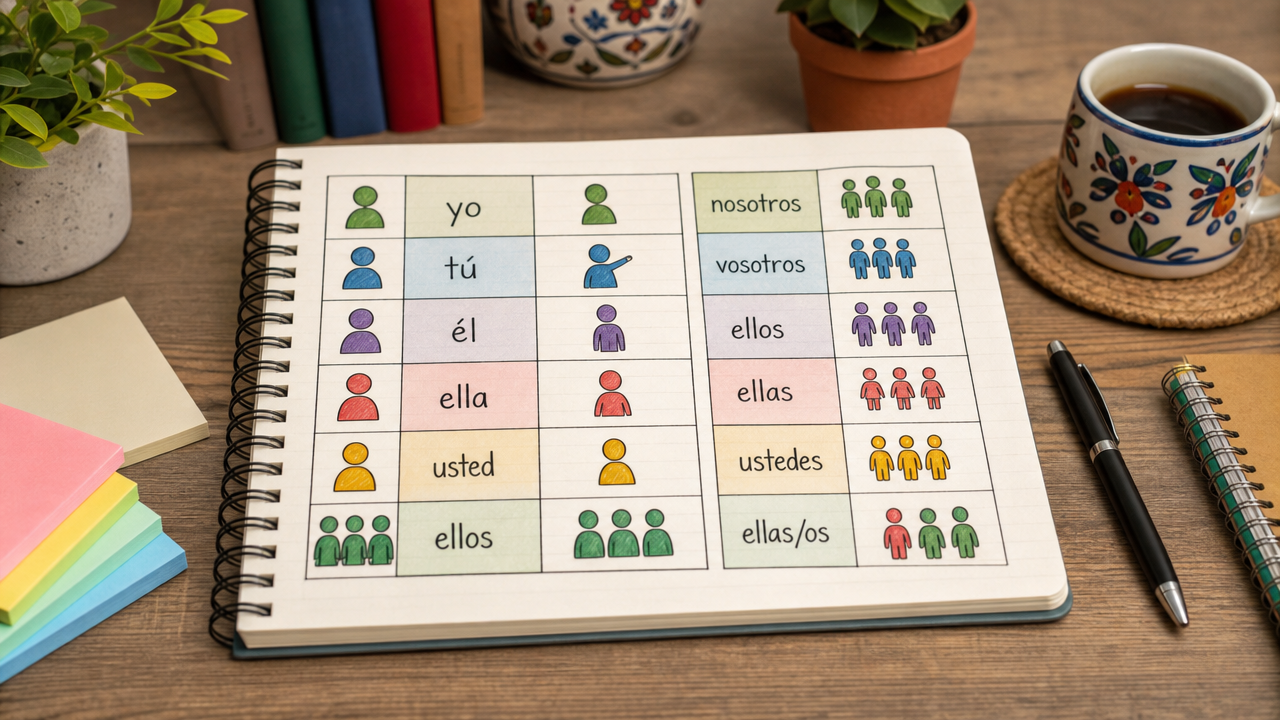
This guide covers subject, object, reflexive, possessive, demonstrative, relative, interrogative, indefinite and special pronouns including se, lo, le, impersonal/passive constructions, clitic placement and regional variations.
1. Subject Pronouns
| English | Spanish |
|---|---|
| I | yo |
| you (informal) | tú |
| he | él |
| she | ella |
| you (formal) | usted |
| we | nosotros/nosotras |
| you plural (Spain) | vosotros/vosotras |
| you plural | ustedes |
| they | ellos/ellas |
Spanish usually drops subject pronouns:
- Hablo español. = I speak Spanish.
- Somos amigos. = We are friends.
- ¿Tienes hambre? = Are you hungry?
2. Direct Object Pronouns
| English | Spanish |
|---|---|
| me | me |
| you | te |
| him/it | lo |
| her/it | la |
| us | nos |
| you plural | os / los / las |
| them | los / las |
- Lo veo. = I see him.
- La conozco. = I know her.
- Nos ayudan. = They help us.
- Los compré. = I bought them.
3. Indirect Object Pronouns
| English | Spanish |
|---|---|
| to me | me |
| to you | te |
| to him/her/you formal | le |
| to us | nos |
| to you plural | os / les |
| to them | les |
- Le escribo. = I write to him/her.
- Nos dio un regalo. = He gave us a gift.
- Les conté la verdad. = I told them the truth.
4. The Personal “a”
Used before a specific person who is the direct object.
- Veo a María. = I see María.
- Conozco a Juan. = I know Juan.
- No veo a mis amigos. = I don't see my friends.
5. Reflexive Pronouns
| Subject | Pronoun |
|---|---|
| yo | me |
| tú | te |
| él/ella | se |
| nosotros | nos |
| vosotros | os |
| ellos | se |
- Me levanto. = I get up.
- Se llama Ana. = Her name is Ana.
- Nos divertimos. = We have fun.
6. Reciprocal Pronouns
- Nos vemos mañana. = We'll see each other tomorrow.
- Se aman. = They love each other.
- Se escriben. = They write to each other.
7. Possessive Pronouns & Adjectives
- mi libro = my book
- tu casa = your house
- su coche = his/her/your/their car
- el mío = mine
- la tuya = yours
- los nuestros = ours
8. Demonstrative Pronouns
| Near | Medium | Far |
|---|---|---|
| este | ese | aquel |
| esta | esa | aquella |
- Este es bueno. = This one is good.
- Esa es mi hermana. = That is my sister.
- Aquellos son antiguos. = Those over there are old.
9. Relative Pronouns
- que – who/that/which
- quien – who/whom
- el que, el cual – formal forms
- cuyo – whose
La mujer que viste. = The woman that you saw.
La persona con quien hablé. = The person with whom I spoke.
10. Interrogative Pronouns
- ¿Quién? = Who?
- ¿Qué? = What?
- ¿Cuál? = Which?
- ¿Cuánto? = How much/many?
11. Indefinite Pronouns
- alguien = someone
- algo = something
- nadie = nobody
- nada = nothing
- todos = everyone
- cada uno = each one
12. The Special Pronoun “se”
Reflexive se
Se lava. = He washes himself.
Reciprocal se
Se conocen. = They know each other.
Impersonal se
Se vive bien aquí. = One lives well here.
Passive se
Se venden casas. = Houses are sold.
13. Accidental “se”
A uniquely Spanish structure showing accidental events.
- Se me cayó el teléfono. = I accidentally dropped the phone.
- Se nos olvidó. = We forgot it.
- Se le rompió el coche. = His car broke down.
14. Double Object Pronouns
When le or les appears before lo/la/los/las, it becomes se.
- Le doy el libro.
- Se lo doy. = I give it to him/her.
- Les envié las cartas.
- Se las envié. = I sent them to them.
15. Pronoun Placement
Before conjugated verbs
- Lo veo.
- Te llamo.
- Se lo doy.
Attached to infinitives
- Quiero verlo.
- Voy a llamarte.
- Necesito decírtelo.
Attached to gerunds
- Estoy viéndolo.
- Estoy explicándoselo.
Attached to affirmative commands
- Dime. = Tell me.
- Hazlo. = Do it.
- Dámelo. = Give it to me.
16. Pronouns with Gustar
- Me gusta. = I like it.
- Me gustan. = I like them.
- Te gusta? = Do you like it?
- Les gustan los libros. = They like books.
17. Lo as a Neutral Pronoun
- Lo sé. = I know.
- No lo entiendo. = I don't understand it.
- Lo creo. = I believe it.
18. Regional Variations
- Vosotros is mainly used in Spain.
- Ustedes is used throughout Latin America.
- Leísmo: some speakers use le instead of lo for masculine people.
- Laísmo and loísmo occur in some regions but are generally non-standard.
19. Master Examples
| Type | Spanish | English |
|---|---|---|
| Direct Object | Lo veo. | I see him. |
| Indirect Object | Le escribo. | I write to him. |
| Reflexive | Se lava. | He washes himself. |
| Reciprocal | Se aman. | They love each other. |
| Accidental se | Se me cayó. | I accidentally dropped it. |
| Double Object | Se lo doy. | I give it to him. |
| Gustar | Me gusta. | I like it. |
20. Biggest Pronoun Traps
- Don't confuse lo/la (direct object) with le (indirect object).
- Remember the personal a with people.
- Le + lo/la becomes se lo / se la.
- Se has many meanings: reflexive, reciprocal, impersonal, passive, accidental.
- Spanish usually omits subject pronouns.
- Object pronouns attach to infinitives, gerunds and affirmative commands.
- Gustar works backwards compared to English.
- Latin America generally uses ustedes instead of vosotros.