
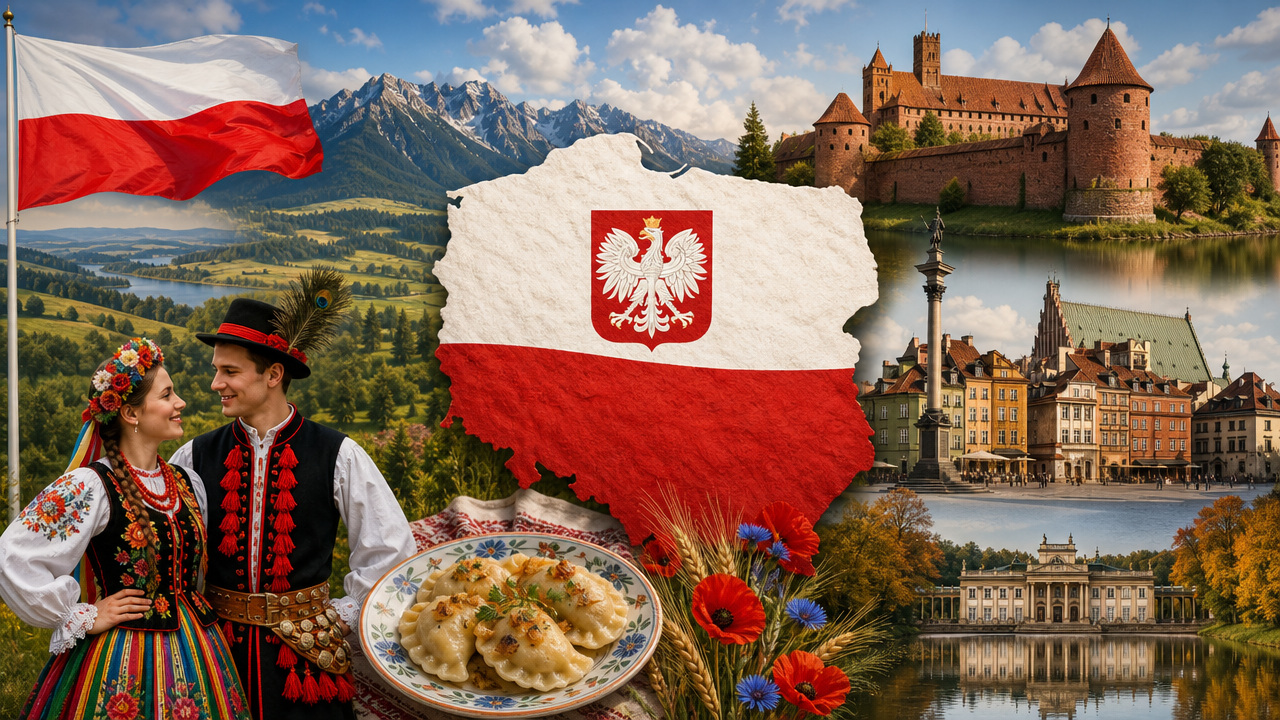
Polish looks intimidating at first, but beneath the consonant clusters and case endings is a logical, expressive, and surprisingly consistent language. These quirks are not obstacles — they are the keys to understanding how Polish works.
Polish words can contain dense consonant clusters, but combinations like sz cz rz and dz become easier once learned as sound units.
Polish has seven cases, which change noun endings and allow flexible word order.
Polish spelling is much more consistent than English once you learn the alphabet and letter combinations.
Polish is often considered one of Europe's most challenging languages for English speakers. At first glance, it is easy to see why: the language seems packed with consonants, complex grammar rules, and words that appear impossible to pronounce.
Yet beneath that intimidating exterior lies a remarkably logical, expressive, and fascinating language. Spoken by more than 40 million people, Polish belongs to the West Slavic branch of languages alongside Czech and Slovak.
Polish is difficult at first because it looks unfamiliar. Once you learn the patterns, many parts of the language become far more predictable than they seem.
1. Polish Has More Consonants Than You Thought Possible
One of the first things learners notice is that Polish words often seem to contain an alarming number of consonants.
happiness
ruthless
beetle
To English speakers, these words can look intimidating. However, Polish pronunciation is much more logical than it appears.
Learn this as one sound, not two separate letters.
Another common combination that appears in many Polish words.
A common spelling pattern that becomes easier with exposure.
Part of a wider family of Polish affricate sounds.
Do not attack long Polish words letter by letter. Break them into sound chunks first.
2. Polish Has Seven Cases
Polish nouns change their endings depending on their role in a sentence. This sounds complicated, but cases are also what give Polish its expressive flexibility.
| Case | Simple learner meaning | Example use |
|---|---|---|
| Nominative | The subject | Who or what is doing the action. |
| Genitive | Possession, absence, quantity | Often used for “of” or “not having”. |
| Dative | Indirect object | Often similar to “to” or “for”. |
| Accusative | Direct object | Who or what receives the action. |
| Instrumental | Means or companion | Often similar to “with” or “by means of”. |
| Locative | Location or topic | Often used after certain prepositions. |
| Vocative | Direct address | Used when calling or addressing someone. |
cat
cat in another sentence role
cat in another sentence role
cat in another sentence role
3. Word Order Is Surprisingly Flexible
English relies heavily on word order. In Polish, case endings often reveal who is doing what, so speakers can rearrange words to change emphasis while keeping the same basic meaning.
Cases may feel hard at first, but they allow Polish speakers to move words around for emphasis, rhythm, and style.
4. Polish Has Nasal Vowels
Polish contains nasal vowels that are somewhat similar to nasal sounds in French and Portuguese.
Appears in words such as mąż
husband
Appears in words such as język
language
5. Polish Distinguishes Between Formal and Informal Speech
| Situation | Form | Use |
|---|---|---|
| Friends and family | ty | Informal “you”. |
| Formal address to a man | Pan | Mr./Sir. |
| Formal address to a woman | Pani | Mrs./Madam. |
Choosing the right form is part of Polish etiquette. It communicates respect, distance, familiarity, and politeness.
6. Diminutives Are Everywhere
Polish speakers love diminutives. These forms make things sound smaller, friendlier, softer, or more affectionate.
house
little house
cat
kitty
7. Polish Has a Detailed Verb System
Polish verbs contain a feature known as aspect Most verbs have imperfective and perfective forms.
To be doing, to do repeatedly, or to focus on the process.
To complete or finish doing something.
Polish verbs often tell you whether an action is ongoing, repeated, attempted, completed, or viewed as a whole.
8. Polish Is Surprisingly Phonetic
Although Polish spelling initially looks intimidating, pronunciation is remarkably consistent. Once learners master the alphabet and common letter combinations, reading becomes much easier than expected.
9. Polish Has Words That Do Not Exist in English
Depending on context, kombinować can mean to figure something out, improvise, find a clever solution, scheme, or work something out by ingenuity.
10. Polish Is Rich in History and Culture
Polish contains influences from Latin, German, French, and Russian while still maintaining a distinct identity. Learning Polish opens the door to a rich literary tradition, including Wisława Szymborska and Czesław Miłosz.
Why Polish Is Easier Than Many Learners Expect
Once the sound system is learned, words become easier to decode.
Polish spelling is often more predictable than English spelling.
Cases and endings become more familiar with exposure.
Prefixes, suffixes, and diminutives help words connect to one another.
The Best Way to Learn Polish's Quirks
The most effective way to learn Polish is through meaningful exposure. Stories, conversations, listening practice, and real-world examples help learners absorb patterns naturally.
- Cases become familiar through repeated examples.
- Pronunciation starts to feel natural.
- Verb aspects begin to make sense in real situations.
- Long words become easier to decode.
A Simple Practice Routine
| Time | Activity | What it trains |
|---|---|---|
| 5 minutes | Read Polish words aloud in chunks | Consonant clusters and pronunciation confidence. |
| 10 minutes | Listen to a short story or dialogue | Cases, word order, and natural rhythm. |
| 10 minutes | Practise conversation with an AI tutor | Formal/informal speech, response speed, and confidence. |
| 5 minutes | Review mistakes and repeat weak words | Retention, spelling, and grammar patterns. |
Final Thoughts
Polish may have a reputation as one of Europe's more challenging languages, but it is also one of the most rewarding. Its rich grammar, expressive vocabulary, fascinating sounds, and cultural depth make it unlike any language most English speakers have encountered before.
For learners, these quirks are not obstacles. They are part of the adventure. Once you begin recognising the patterns behind Polish, you will discover a language that is far more logical and beautiful than its intimidating reputation suggests.
Good luck — and remember, Polish becomes much friendlier once you start seeing the patterns.
Ready to make Polish feel less intimidating?
Use Polly2 to practise Polish through stories, AI conversation, pronunciation support, adaptive review, and structured Learning Journeys.
Start Learning Free