
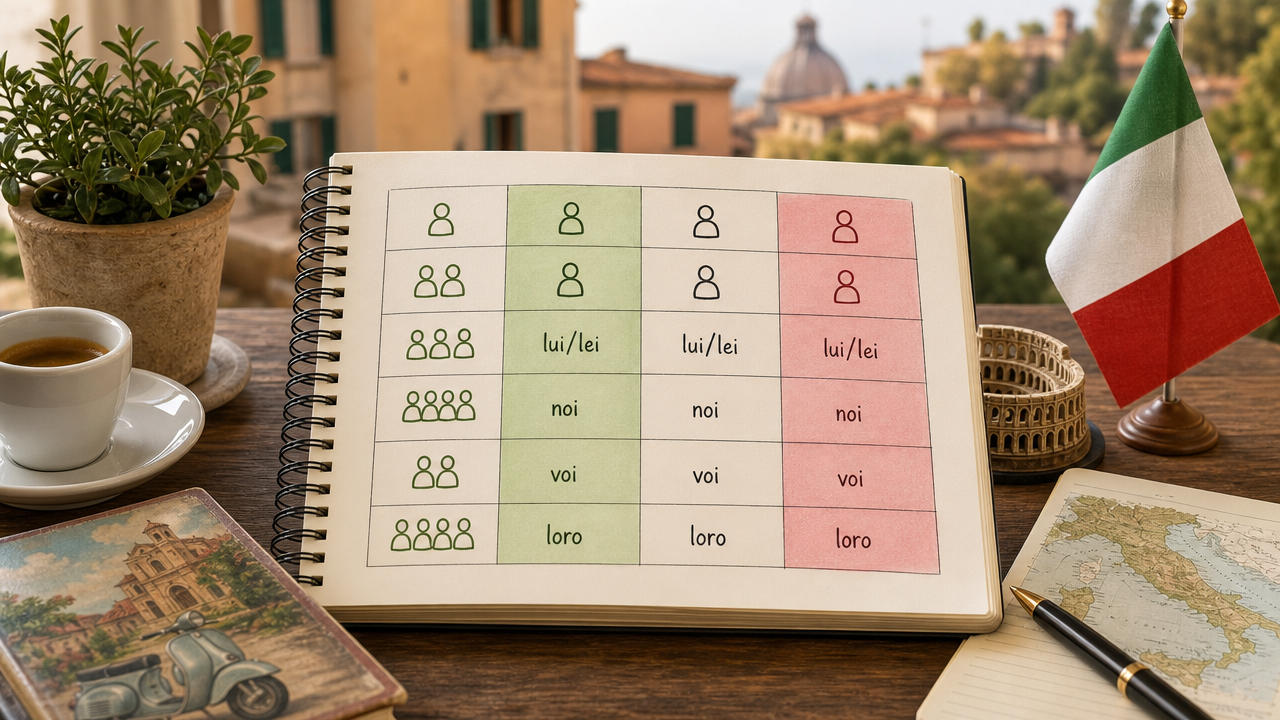
Italian pronouns include subject, object, reflexive, possessive, demonstrative, relative, interrogative, indefinite, and special pronouns such as ci, ne, and si.
1. Subject Pronouns
| English | Italian |
|---|---|
| I | io |
| you singular | tu |
| he | lui |
| she | lei |
| we | noi |
| you plural | voi |
| they | loro |
Italian often drops subject pronouns because the verb ending already shows the subject.
- Io parlo italiano. = I speak Italian.
- Parlo italiano. = I speak Italian.
- Siamo pronti. = We are ready.
2. Formal “You”: Lei
Lei is used as the polite singular form of “you”. It takes a third-person singular verb.
- Come sta? = How are you?
- Lei è pronto? = Are you ready?
- Le mando un’email. = I’ll send you an email.
3. Direct Object Pronouns
Direct object pronouns answer “whom?” or “what?”
| English | Italian |
|---|---|
| me | mi |
| you | ti |
| him / it | lo |
| her / it | la |
| us | ci |
| you plural | vi |
| them masculine | li |
| them feminine | le |
- Mi vedi? = Do you see me?
- Lo conosco. = I know him.
- La vedo. = I see her.
- Li compro. = I buy them.
4. Indirect Object Pronouns
Indirect object pronouns answer “to whom?” or “for whom?”
| English | Italian |
|---|---|
| to me | mi |
| to you | ti |
| to him | gli |
| to her | le |
| to us | ci |
| to you plural | vi |
| to them | gli / loro |
- Mi dai una mano? = Can you give me a hand?
- Gli telefono. = I phone him.
- Le scrivo. = I write to her.
- Gli ho detto la verità. = I told them the truth.
5. Direct vs Indirect
- Lo chiamo. = I call him.
- Gli telefono. = I phone him.
- La guardo. = I look at her.
- Le parlo. = I speak to her.
6. Stressed Pronouns
Stressed pronouns are used after prepositions or for emphasis.
| English | Italian |
|---|---|
| me | me |
| you | te |
| him | lui |
| her | lei |
| us | noi |
| you plural | voi |
| them | loro |
- Vieni con me? = Are you coming with me?
- Parlo di te. = I’m talking about you.
- Questo regalo è per lei. = This gift is for her.
7. Reflexive Pronouns
| Subject | Reflexive Pronoun |
|---|---|
| io | mi |
| tu | ti |
| lui / lei | si |
| noi | ci |
| voi | vi |
| loro | si |
- Mi lavo. = I wash myself.
- Ti svegli presto? = Do you wake up early?
- Si chiama Marco. = His name is Marco.
- Ci divertiamo. = We are having fun.
8. Reflexive Pronouns in the Past Tense
Reflexive verbs use essere in compound tenses.
- Mi sono svegliato. = I woke up. Masculine speaker.
- Mi sono svegliata. = I woke up. Feminine speaker.
- Ci siamo divertiti. = We had fun.
- Si è arrabbiata. = She got angry.
9. Reciprocal Pronouns
Reflexive pronouns can also mean “each other”.
- Ci vediamo domani. = We’ll see each other tomorrow.
- Si amano. = They love each other.
- Si conoscono bene. = They know each other well.
10. Possessive Pronouns and Adjectives
| English | Masculine Singular | Feminine Singular | Masculine Plural | Feminine Plural |
|---|---|---|---|---|
| my | mio | mia | miei | mie |
| your | tuo | tua | tuoi | tue |
| his / her | suo | sua | suoi | sue |
| our | nostro | nostra | nostri | nostre |
| your plural | vostro | vostra | vostri | vostre |
| their | loro | loro | loro | loro |
- Il mio libro = my book
- La mia casa = my house
- I miei amici = my friends
- Questo è il mio. = This one is mine.
11. Demonstrative Pronouns
| Italian | Meaning |
|---|---|
| questo | this one, masculine |
| questa | this one, feminine |
| questi | these, masculine |
| queste | these, feminine |
| quello | that one, masculine |
| quella | that one, feminine |
| quelli | those, masculine |
| quelle | those, feminine |
- Questo è buono. = This one is good.
- Quella è mia sorella. = That one is my sister.
- Preferisco questi. = I prefer these.
12. Relative Pronouns
Che
- Il ragazzo che parla è mio fratello. = The boy who is speaking is my brother.
- Il libro che leggo è interessante. = The book that I am reading is interesting.
Cui
- La persona di cui parlo = the person I am talking about
- Il ragazzo con cui studio = the boy I study with
- La città in cui vivo = the city I live in
Il quale / La quale / I quali / Le quali
- Il professore, il quale vive a Milano, è molto famoso. = The professor, who lives in Milan, is very famous.
13. Interrogative Pronouns
| Italian | Meaning |
|---|---|
| chi | who / whom |
| che cosa / cosa / che | what |
| quale | which |
| quanto | how much / how many |
- Chi è? = Who is it?
- Cosa vuoi? = What do you want?
- Quale preferisci? = Which one do you prefer?
- Quanti ne vuoi? = How many do you want?
14. Indefinite Pronouns
- Qualcuno ha chiamato. = Someone called.
- Ho visto qualcosa. = I saw something.
- Non ho visto nessuno. = I didn’t see anyone.
- Non voglio niente. = I don’t want anything.
- Tutti sono arrivati. = Everyone arrived.
15. The Special Pronoun “ci”
Ci = us
- Ci vedono. = They see us.
- Ci parlano. = They speak to us.
Ci = there
- Vai a Roma? Sì, ci vado domani. = Are you going to Rome? Yes, I’m going there tomorrow.
Ci with certain verbs
- Ci credo. = I believe it.
- Ci penso. = I’m thinking about it.
C’è / Ci sono
- C’è un problema. = There is a problem.
- Ci sono tre persone. = There are three people.
16. The Special Pronoun “ne”
Ne can mean “of it”, “of them”, “from there”, “about it”, or “some”.
- Ne voglio un po’. = I want some of it.
- Ne ho tre. = I have three of them.
- Che ne pensi? = What do you think of it?
- Ne parliamo domani. = We’ll talk about it tomorrow.
17. Combined Pronouns
| Combination | Example | Meaning |
|---|---|---|
| me lo | Me lo dai? | Will you give it to me? |
| te lo | Te lo prometto. | I promise it to you. |
| glielo | Glielo dico. | I tell it to him/her/them. |
| ce lo | Ce lo portano. | They bring it to us. |
| ve lo | Ve lo preparo. | I prepare it for you all. |
| me ne | Me ne dai un po’? | Will you give me some? |
| se ne | Se ne va. | He/she is leaving. |
18. Se ne and -sene
Se ne is made from si plus ne. When attached to verbs, it often becomes -sene.
- Se ne va. = He/she is leaving.
- Me ne vado. = I’m leaving.
- Voglio andarmene. = I want to leave.
- Vattene! = Go away!
- Se n’è andato. = He left.
Common verbs with -sene
- andarsene = to go away
- fregarsene = not to care
- accorgersene = to notice / realize
- intendersene = to know about something
19. Placement of Pronouns
Before conjugated verbs
- Lo vedo. = I see him.
- Ti chiamo. = I call you.
- Ne voglio tre. = I want three of them.
Attached to infinitives
- Voglio vederlo. = I want to see him.
- Devo chiamarti. = I have to call you.
- Voglio andarci. = I want to go there.
Attached to commands
- Guardami! = Look at me!
- Dimmi! = Tell me!
- Fallo! = Do it!
- Vattene! = Go away!
Attached to gerunds
- Vedendolo, ho capito. = Seeing him, I understood.
- Parlandone, mi sono emozionato. = Talking about it, I got emotional.
20. Pronouns in the Past Tense
With direct object pronouns, the past participle agrees with the pronoun.
- L’ho visto. = I saw him.
- L’ho vista. = I saw her.
- Li ho comprati. = I bought them.
- Le ho comprate. = I bought them.
21. Pronouns with Piacere
Italian uses an indirect-object structure with piacere.
- Mi piace. = I like it.
- Mi piacciono. = I like them.
- Ti piace? = Do you like it?
- Gli piacciono i film italiani. = He/they like Italian films.
22. Special Uses of “si”
Reflexive si
- Si lava. = He/she washes himself/herself.
Reciprocal si
- Si amano. = They love each other.
Impersonal si
- In Italia si mangia bene. = In Italy, people eat well.
- Qui si parla italiano. = Italian is spoken here.
Passive si
- Si vende una casa. = A house is for sale.
- Si vendono case. = Houses are for sale.
23. “Lo” as a Neutral Pronoun
Lo can refer to an entire idea.
- Lo so. = I know.
- Non lo capisco. = I don’t understand it.
- Lo penso anch’io. = I think so too.
24. Common Pronoun Patterns
Ce l’ho
- Ce l’ho. = I have it.
- Ce l’hai? = Do you have it?
- Ce l’ha. = He/she has it.
- Ce l’abbiamo. = We have it.
- Ce l’avete? = Do you all have it?
- Ce l’hanno. = They have it.
Ce ne sono
- Ce n’è uno. = There is one of them.
- Ce ne sono molti. = There are many of them.
- Non ce ne sono. = There aren’t any.
25. Master Examples
| Type | Italian | English |
|---|---|---|
| Direct object | Lo vedo. | I see him. |
| Indirect object | Gli scrivo. | I write to him. |
| Reflexive | Marco si lava. | Marco washes himself. |
| Ne | Ne ho tre. | I have three of them. |
| Ci | Ci vado. | I’m going there. |
| Combined | Glielo do. | I give it to him/her. |
| Formal direct | La chiamo domani. | I’ll call you tomorrow. |
| Formal indirect | Le scrivo domani. | I’ll write to you tomorrow. |
26. Biggest Pronoun Traps
- lo, la, li, le are direct object pronouns.
- gli and le are indirect object pronouns.
- ci can mean “us”, “there”, or “about/to it”.
- ne can mean “some”, “of it”, “about it”, or “from there”.
- si can be reflexive, reciprocal, impersonal, or passive.
- Pronouns usually go before conjugated verbs.
- Pronouns attach to infinitives, commands, and gerunds.
- Past participles agree with direct object pronouns.
- se can mean “if”, but in se ne va, it is a reflexive pronoun.
- Some verbs should be learned as full expressions: andarsene, fregarsene, accorgersene, intendersene.