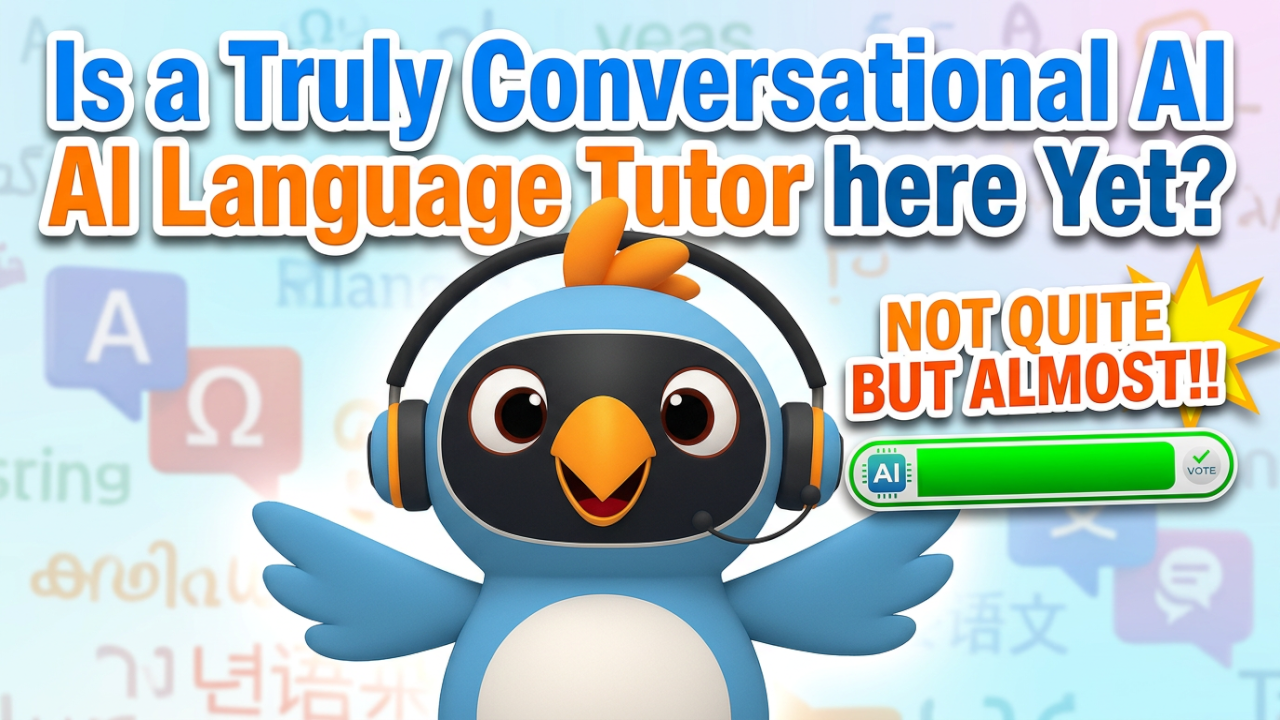
AI language tutors can already explain grammar, correct mistakes, role-play conversations, and practise dozens of languages. But to feel truly conversational, they still need faster timing, interruption handling, backchannels, emotional awareness, and long-term learner memory.
Not quite yet — but the gap between chatbot and natural conversation is closing quickly.
Natural conversation depends on timing, interruption, reaction, memory, and emotional awareness — not just correct words.
Language learners need to survive real conversations: hesitation, mistakes, topic changes, clarification, and pressure.
For decades, language learners have dreamed of the perfect tutor.
One that never gets tired. Never runs out of patience. Never judges mistakes. And is available whenever you want to practise.
Artificial intelligence has brought us closer to that dream than ever before.
Today's AI language tutors can explain grammar, correct mistakes, generate exercises, role-play conversations, and help learners practise dozens of languages.
The answer is simple: not quite, but we are getting remarkably close.
The Difference Between Chatting and Conversing
Most modern AI language tutors are impressive. You can ask questions, practise dialogues, receive corrections, and even hold surprisingly complex discussions.
Yet most interactions still follow a turn-based pattern.
The learner asks a question or says a sentence.
The system detects the end of speech and processes the input.
The answer is generated and spoken back.
The learner listens, then prepares the next turn.
Human conversation does not work like that. Real conversations are messy. People interrupt each other, hesitate, laugh, react emotionally, change direction, finish each other's sentences, and give feedback while listening.
A tiny signal that shows surprise or interest.
A small listening cue that keeps the other person speaking.
A prompt that encourages continuation.
A sign of understanding and conversational grounding.
Most AI tutors can chat. Far fewer can participate in the rhythm of real conversation.
The Timing Problem
One of the least discussed challenges in conversational AI is response timing.
Human conversation is incredibly fast. Natural turn-taking often happens within a few hundred milliseconds, and in some contexts the expected response window can feel even shorter.
This means humans are not waiting until someone has completely finished before deciding what to say next. We predict where the conversation is going and prepare while listening.
A voice system can be intelligent and still feel unnatural if the response arrives slightly too late. Fluency is not just about words. It is also about rhythm.
| Conversation skill | Human conversation | Typical AI voice tutor |
|---|---|---|
| Turn-taking | Predictive and fast | Often waits for a complete turn |
| Interruptions | Natural and frequent | Often awkward or unsupported |
| Backchannels | Constant small listening signals | Often missing or delayed |
| Repair | Immediate clarification | May require a new prompt |
| Emotional response | Dynamic and context-aware | Still inconsistent |
Why Current AI Voice Tutors Still Feel Robotic
Many AI voice systems are built around a traditional pipeline:
This architecture has enabled enormous progress, but it also creates friction.
The system must listen, transcribe, process, generate text, convert that text into audio, and then play the audio back. Each stage adds latency.
Even when the final answer is intelligent, the interaction can still feel turn-based rather than conversational.
The Text-to-Speech Bottleneck
In many systems, once the text-to-speech audio begins playing, the response is effectively committed.
The audio is generated and sent without a natural way to interrupt, stop, reshape, or redirect the spoken response in real time.
That is not how human beings talk.
If the learner interrupts, the tutor needs to stop naturally and adapt.
If the learner sounds confused, the tutor should clarify immediately.
If the learner changes direction, the tutor should follow smoothly.
The Science Behind Natural Conversation
Natural conversation depends on far more than words. It includes timing, shared context, interruptions, repair, emotional awareness, and conversational grounding.
Responses need to arrive quickly enough to feel socially natural.
Small reactions like “mm-hmm” and “I see” keep the conversation alive.
Real speakers recover from misunderstandings without restarting the whole exchange.
Conversation feels natural when both sides remember what has already happened.
Tone, confidence, hesitation, and frustration all matter.
Why This Matters for Language Learners
The goal of language learning is not simply to complete lessons. The goal is conversation.
And conversation is unpredictable.
- Responding quickly.
- Recovering from mistakes.
- Asking for clarification.
- Handling interruptions.
- Following topic changes.
- Understanding emotional tone.
- Speaking naturally under pressure.
These skills cannot be developed through flashcards alone. They require interactive practice.
Enter NVIDIA PersonaPlex
One of the most exciting developments in conversational AI is NVIDIA PersonaPlex.
PersonaPlex is designed to address several of the problems that make current AI conversations feel unnatural. Instead of treating conversation as a sequence of isolated turns, it moves toward a full-duplex conversational model.
The system can listen and speak at the same time. That matters because real humans listen, prepare, react, interrupt, and adapt continuously.
The tutor can respond more naturally when the learner cuts in or changes direction.
The tutor can provide small listening signals instead of waiting silently.
The tutor can feel less generic and more socially believable.
Learners can practise with a teacher, colleague, tour guide, café partner, or other persona.
Why Persona Matters
Imagine learning Spanish. Would you rather practise with a generic AI assistant, a patient Spanish teacher, a friendly Madrid tour guide, a Spanish-speaking colleague, or a relaxed conversation partner in a café?
Persona changes the learning experience because language is social. We do not speak only to exchange information. We speak to connect.
A language tutor with a consistent personality, tone, role, and conversational style can make practice more engaging and more realistic.
Memory: The Missing Ingredient in Most AI Tutors
Natural conversation is not only about timing. It is also about memory.
A good human tutor remembers what you struggled with last week, your pronunciation issues, the grammar patterns you keep missing, and which words still need work.
Many AI tutors can hold impressive conversations but forget what happened once the session ends. That is not how effective tutoring works.
How Polly2 Uses Memory
At Polly2, memory is already part of the learning experience. In Polly2's Progress Practice game, when a learner gets something wrong, the platform does not simply move on.
That mistake is remembered. The question is then given priority and retested in later practice sessions to help ensure the learner improves.
A mistake is not a failure. It is one of the clearest signals a tutor can use to personalise future practice.
What Still Needs To Be Solved
Even with rapid progress, truly human-level conversational AI remains difficult. Several challenges still need to improve.
The ideal tutor should remember progress across weeks, months, and years.
The tutor should recognise frustration, confusion, boredom, excitement, and hesitation.
Language is connected to humour, politeness, social expectations, and culture.
The tutor must stop, adapt, clarify, and change direction mid-conversation.
Responses must be fast enough to feel natural, but not so fast that they feel artificial.
What This Means for Polly2
At Polly2, the vision has always been larger than exercises and vocabulary lists. The future of language learning is conversational.
Not just AI that answers questions, but AI that feels like a genuine language-learning companion.
Structured pathways help learners know what to study next.
Stories make vocabulary and grammar more memorable.
Mistakes are remembered and used for future reinforcement.
Technologies like PersonaPlex point toward more human-like spoken dialogue.
Tutors can become more engaging, role-specific, and socially believable.
So, Is a Truly Conversational AI Language Tutor Here Yet?
Not quite.
But for the first time, we can clearly see the path.
The last few years brought remarkable advances in AI reasoning. The next few years will focus on something even more important: making AI feel natural.
When AI can listen, respond, remember, interrupt, adapt, encourage, and converse with human-like rhythm, language learning will change forever.
The future of language learning will not be built around exercises alone. It will be built around conversations with memory, personality, natural timing, adaptation, correction, and encouragement.
We are not quite there yet. But we are closer than we have ever been before.
Ready to practise with an AI language tutor?
Use Polly2 to combine AI conversation, Learning Journeys, story-based learning, adaptive practice, and memory-driven reinforcement.
Start Learning Free